
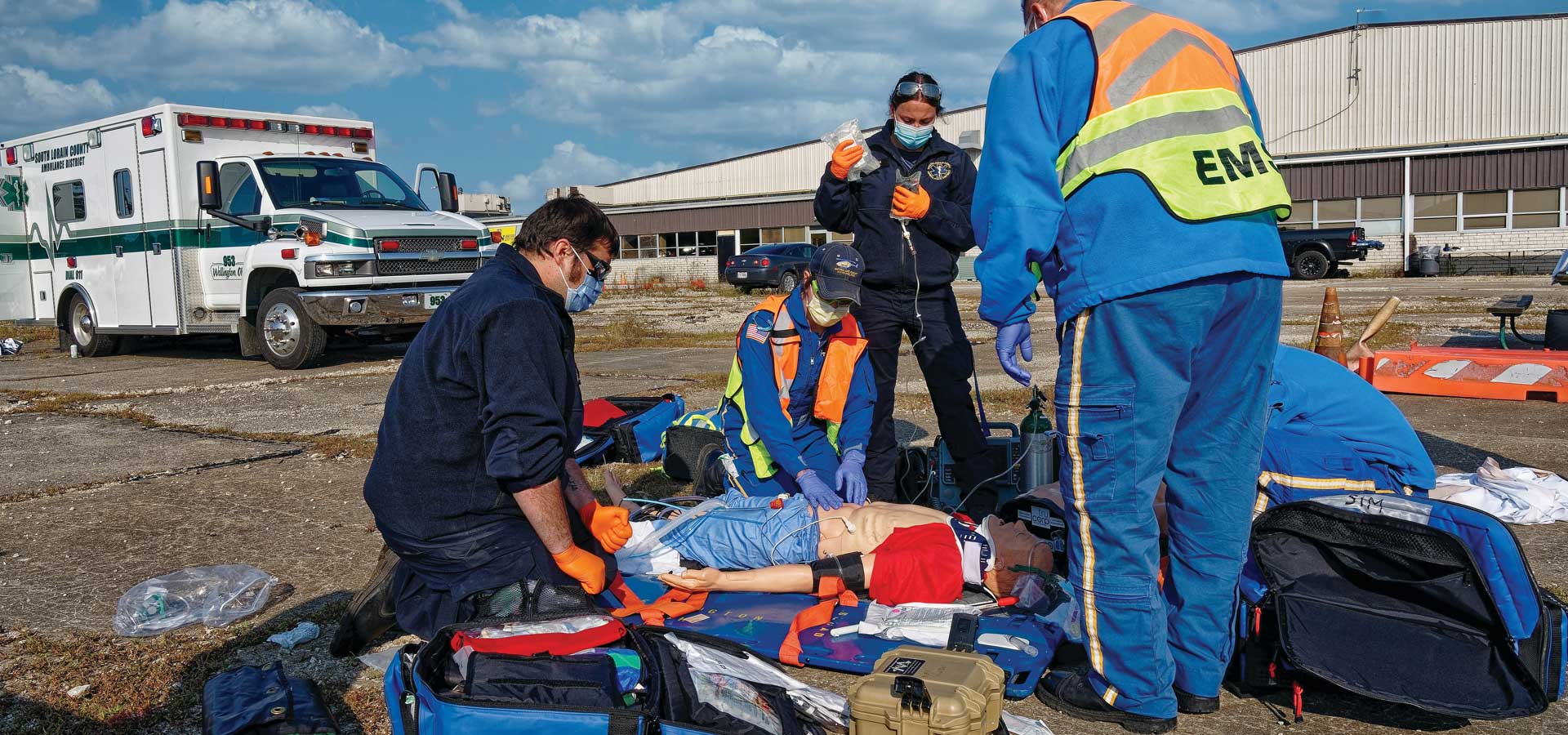
Fine-tune your traumatic brain injury assessment skills with hands-on training in the MetroHealth Simulation Institute.
FieldBrief Issue 1
Published March 24, 2026
Practice TBI Assessment Before It Happens in the Field
The “golden hour”—the timeframe for stabilization and rapid transport—is critical for traumatic brain injury (TBI). Simulation training helps first responders practice the decisions that matter most during those minutes.
“The stakes are high with traumatic brain injury. You have a few seconds or minutes to get something right,” says Sarah Greywitt, Senior Instructional Designer in the MetroHealth Simulation Institute.
“First responders come across traumatic brain injury periodically, and they don’t have the luxury of getting things wrong. Simulation is incredibly useful because it gives them the opportunity to practice traumatic brain injury assessment in a safe space.”
These high-intensity, objective-based training sessions help you practice your existing knowledge-based clinical skills and develop new ones.
Improving TBI Field Assessment
Vital sign evaluation is the key to identifying and monitoring TBI.
Using computer-controlled patient mannequins and simulator-manipulated monitors, case-based scenarios test first responders’ actions in real-life situations.
“Instead of using preset monitors, simulation operators control the patient’s vital signs in real time. They adjust the numbers based on what responders do during the scenario,” Greywitt says.
In many scenarios, responders must maintain the following targets during care:
- Systolic pressure above 90 mmHg
- Oxygen saturation above 90%
- CO2 between 35 and 45 mmHg
Overcoming TBI Assessment Challenges
Accurately assessing a patient with TBI can be complicated.
Patients may have multiple injuries or scenes may be crowded and chaotic. Simulation training helps first responders cut through the noise to conduct an evaluation that leads to a valid appraisal.
Greywitt says going through training and debriefing can overcome these on-scene challenges:
- Exaggerated symptoms: Practicing validity checks—simple cognitive tests that patients with severe impairment should still be able to pass—helps first responders detect when patients embellish the impact of injuries.
- Missed injuries: Complex training scenarios encourage deeper evaluations that look beyond apparent injuries to find less obvious damage that may impact TBI severity.
- Misinterpreting symptoms: Repeated practice helps differentiate behaviors caused by TBI from those triggered by anxiety, confusion or pain.
The MetroHealth Difference
The MetroHealth Simulation Institute provides high-fidelity training designed to prepare first responders for TBI assessment in a range of real-world scenarios. When necessary, supervisors can recommend these free sessions.
In these intense 30-minute to one-hour training sessions, you can anticipate:
- Case-based scenarios conducted in the field and simulation lab
- Case-based scenarios reinforce vital sign monitoring and decision-making
- Hands-on activities designed to test clinical knowledge and judgement
- Post-training debriefing with a trained simulation operator to discuss performance and areas of improvement
“We provide all patient information a first responder would have in a real-life situation to make our training scenarios as close to reality as possible,” Greywitt says. “With these details and our resources, we ensure trainees get the critical action guidance and practice needed to best serve patients.”
To claim EMS Continuing Education for this edition of FieldBrief, please visit metrohealth.org/fieldbrief and complete a brief survey. The survey link is located below the list of articles.
MetroHealth Medical Center is a State of Ohio Approved Continuing Education Site #1202
Key Takeaways
- Simulations offer 30 minutes to 1 hour of intense TBI assessment training.
- Case-based scenarios reinforce vital sign evaluation.
- Simulation training helps first responders overcome real-world challenges with TBI appraisal.